

 August 18
2025
August 18
2025
 5 min read
Pyramid patterns are one of the most popular exercises for Python beginners because they strengthen logic building and understanding of nested loops. These patterns may look simple, but they teach how loops, spaces, and characters work together to create structured output. Whether you're preparing for interviews or brushing up on your fundamentals, learning to print pyramid patterns is a great way to sharpen your programming skills. In this guide, we’ll explore how to build a clean pyramid pattern using Python for loops.

Pyramid patterns are created by printing characters in a structured, symmetrical shape that resembles a triangle or mountain. To generate such patterns in Python, we use nested for loops, where one loop controls the number of rows while the other handles spaces and characters.
Understanding the relationship between spaces and symbols is crucial because pyramid shapes rely on perfect alignment.
A standard pyramid pattern consists of rows that increase in size from top to bottom. The top row usually starts with a small number of characters, and each subsequent row expands by adding more characters. To maintain symmetry, we must also adjust the spaces before each row. This combination of spaces and stars creates the recognizable pyramid structure. Usually, the total number of stars in each row follows the formula 2 * row - 1. As the row number increases, the width grows evenly on both sides, forming a centered pattern.
Nested loops make this process simple. The outer loop determines how many rows the pyramid will have. The first inner loop manages the spaces on the left side, ensuring the stars begin at the correct position. The second inner loop prints the stars necessary for that row. This separation of concerns—spaces and stars — helps keep the logic organized and easy to understand.
For beginners, pyramid patterns offer a perfect introduction to nested loops, arithmetic progression, and visualizing program flow. By changing the number of rows, you can generate pyramids of different sizes. Once the concept is clear, you can extend it to inverted pyramids, hollow pyramids, diamond shapes, and many creative patterns.
Another important concept is working with indentation and print statements. Using print("*", end="") ensures stars remain on the same line, while a final print() moves the cursor to the next row. These small details help produce clean and accurate shapes.
Pyramid pattern programs are also commonly used in coding interviews, logical reasoning tests, and academic assignments. They help evaluators understand how well a student can break down a problem, recognize repeated tasks, and implement nested logic efficiently.
Ultimately, learning how to create pyramid patterns is more than just printing stars; it trains your mind to think algorithmically. The combination of loops and mathematical logic builds confidence in writing structured Python programs. Once you understand the underlying flow, you can create dozens of different patterns with small variations in logic.
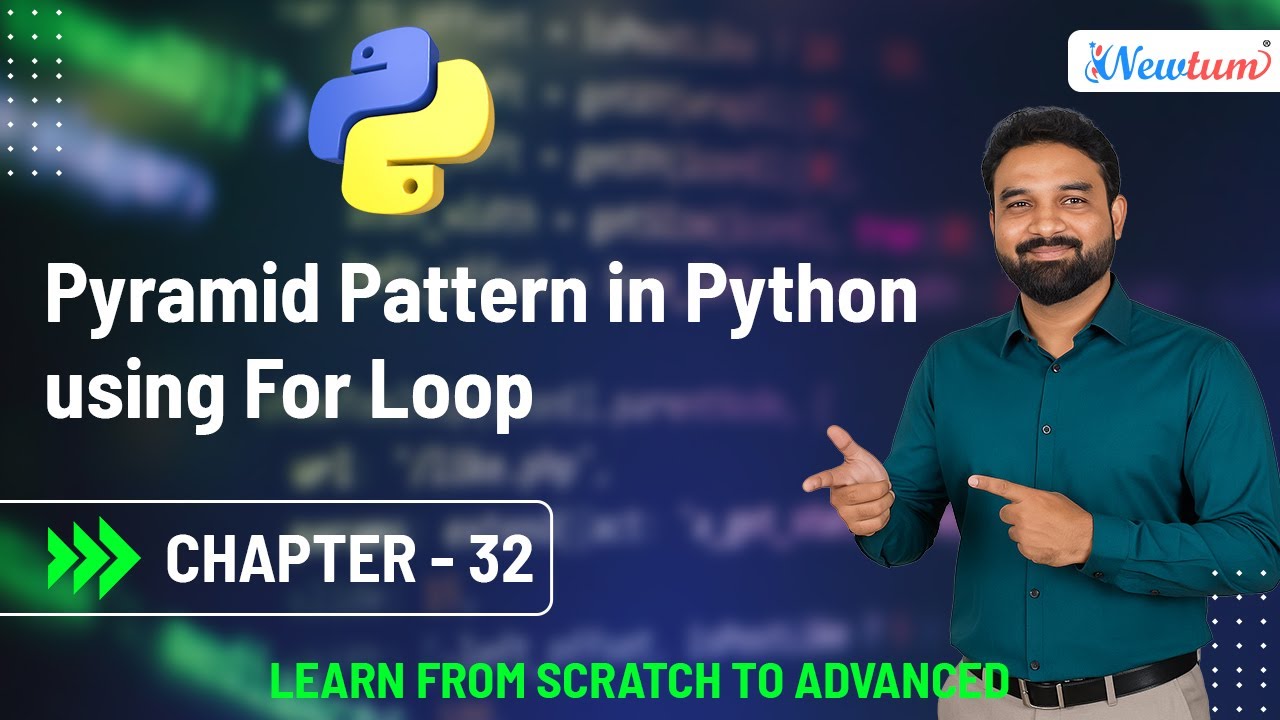
Watch on YouTube learn pyramid patterns with visual demonstrations.
Creating pyramid patterns in Python is an excellent way to strengthen your concepts of loops, spacing, and logical structure. With nested loops and simple mathematical formulas, you can generate elegant and balanced patterns for practice or interviews. Once you master the basic pyramid, you can explore countless variations that enhance your problem-solving skills and deepen your understanding of Python programming.
By adjusting the number of spaces and using the formula 2 * row - 1, the stars expand evenly on both sides, creating a centered shape.
Yes. Increasing the rows variable will automatically generate a taller and wider pyramid without changing the core logic..
Yes, because one loop handles spaces while the other prints stars. Without nesting, the shape cannot be aligned properly.
Absolutely. You can create inverted pyramids, hollow pyramids, diamonds, hourglass patterns, and many more variations by modifying the logic.
Pattern programs turn simple loops into beautiful logic, helping beginners visualize the true power of Python.
— Manoj KolheUnlock the tools and insights you need to thrive on social media with Newtum. Join our community for expert tips, trending strategies, and resources that empower you to stand out and succeed.

Newtum is an emerging online academy offering a wide range of high-end technical courses for people of all ages. We offer courses based on the latest demands and future of the IT industry.
© Newtum, Inc. All Rights Reserved.


